Sunday, 15 September 2013

Yangon & Golden Rock

After meeting my G Adventures group at the hotel in Yangon on the Saturday night, our first activity was to visit Shwedagon pagoda - which is the most sacred site in the country - on Sunday morning.


In pretty much most of downtown Yangon you can't miss this immense stupa - the city's defining image and a symbol of Burmese identity for 2500 years. We took an elevator up to it, but you get more 'merit' by walking up the long covered steps, so this is what the locals tended to do (bare foot of course - no shoes allowed in pagodas in this region!)

The stupa is built on a hill, enshrining the hair relics of the Buddha and has grown in size as gold leaf was added to the outside. It's now 98m tall and has more than 53 metric tonnes of gold!


Inside there is not just the large stupa but 82 other buildings - smaller stupas, temples and statues representing the guardian animals for each day of the week. There are 8 of these in total as Wednesday is split into 2 - elephant with tusks and elephants without tusks. Each person would make offerings to the statue that represents the day of the week they are born - with Wednesday morning and afternoon being different.

Can't remember which day this one was...

When we went it was raining and being Sunday lots of local people were visiting in their days off - so trying to get a picture without umbrellas in it was a challenge that some of the group were determined to try, not sure if they succeeded though! Walking bare foot in the rain made the ceramic tiles very slippery and after an hour there we all had pruned toes!


So a little education on pagodas for you - pagoda refers to a religious site generically, however the focus of the site can then be either a solid monument, which is a stupa, or hollow, which is a temple. Sometimes the main stupa or temple is surrounded with ancillary stupas or temples. The Buddhist belief in Myanmar is that paying for a stupa or temple will bring merit for the next life and for Shwedagon this is the out holy place in which to gain the merit - hence the 82 buildings surrounding it and also the accumulation of gold on the main stupa (gold leaf is commonly used as an offering around Myanmar - more on this later!)

After the stupa we headed out of Yangon up to Mount Kyaiktiyo, stopping briefly at the Second World War cemetery and monument on the way. This honoured the British and local groups who fought and fell in the region during the war as Burma was under colonial rule at the time.

When we got to the town of Kyaikto we had to transfer to a truck with benches (padded for the tourists, not for the locals!) to make the trip up to the 'base camp' at Kinpun. From here is either pay more to get the truck to the top, hire a sedan chair (!) or walk up the winding path. A few of us elected to walk and we got wet! Not from the rain, which thankfully held off, but just from sweat - boy it was humid!!

Truck shot!

The reason to come here though? To see the Golden Rock at the top of the mountain - the third most sacred place in Myanmar. This rock balances precariously on a ledge at the top of the mountain and has remained there even through earthquakes - surely proving that it must be a miracle?!


The rock is golden due to the gold leaf applied by many pilgrims and visitors and is topped by a stupa containing a Buddha hair donated by a hermit in the 11th century. Interesting fact - only men bare allowed to get close and touch the rock, I'm not 100% sure why - there doesn't seem to be a restriction at less sacred sites.... So I paid Stephen to do the deed for me, I should have some merit for the next life!


We were lucky to have a beautiful sunset at the rock with most clouds chased away and those remaining adding contrast to the sky by being lit up.

We also saw some of the ubiquitous Burmese dogs - a lot of the dogs and cats live off the offerings at the temples and unfortunately with walking around bare foot and not paying attention to the tiles can result in some squidging between the toes - best not to look and just find a puddle to wash it off in!

Early morning cloud view from the hotel up the mountain.

The next morning we were up early to walk back down the hill - I think harder than going up - and also to see the monks collecting alms. All Buddhist households give alms - usually this results in an extra pot of rice and food being made to dole out to the monks at their early morning collections. For wealthier families it will include donating to the temples and monasteries - the monks collect all things, including sweets and cash, not just rice and curry. The food they collect is communal - gathered up at the monastery and dished out equally. However they only eat before midday - nothing after, I guess if you're up at 4am you go to bed early!


When we'd finished walking down the mountain we headed to the airport to fly up to Mandalay, the second biggest city in Myanmar.

Mandalay mingalaba!

One thing that is fantastic about Myanmar is the people - everywhere we go you are greeted by smiles and mingalaba! (Welcome or hello in Burmese), saying it back certainly got approval from the locals!

After a nice evening in Mandalay we woke up to floods of rain the next day, after preparing umbrellas, rain coats and flip flops (easier to take off when entering pagodas) we headed into Mandalay to explore.


Our first stop was the Golden Palace - this is currently part of a monastery - but used to be the Kings personal rooms before his death. His son had the whole thing dismantled and transported from the original palace. 


It's an impressively carved teak wood building - very atmospheric in the rain! There are celebrated carvings called jakatas with explain the Buddha's previous lives before he reached nirvana. The name of the palace comes from the gold leaf that was used to decorate the inside. It's a shame that its suffering from the effects if the weather as the carvings on the outside show - it also looks like some pieces have been pried off :(


Next up was the largest book in the world! This accolade goes to Kuthodaw Paya - it has pagodas covering all 729 marble slabs telling the Tripitaka canon of Theravada Buddhism in the Myanmar language. Very close by is another in the original Balinese language.


Here I donated some beautiful lotus flowers to the Buddha - Kai told me that meant I could make a wish for something from Buddha.


Kai and Amy are a great addition to our group - they are American citizens but born in Burma (before the name change), educated in medicine and practised in England before heading to the USA to further their careers. Having native speakers here who know all the stories and history is great - they are assistant guides! It also enables us to ask frank questions about the recent history - this would be inappropriate to ask locals. They can also interpret menus and recommend things to eat...

We visited the second most sacred site in Myanmar next - Mahamuni Paya. This 4m tall Buddha image is also off limits to women - however plenty of men have applied gold leaf over the years - it's grown 15cm deep in a hundred years, but has distorted the shape of the Buddha. Also as a nod to technology you can watch them do this on CCTV - great for the women getting a man to do it on their behalf! 


Before & after pictures - the first is from 1901, the second 1930s

Then 1970s and finally a few years back...

The boys had to covet their knees with the traditional longi. We all appreciated Con's t shirt too!

The Paya includes rooms with paintings showing the story of this image - from it's casting under the supervision of Buddha through to its current placement in the pagoda, and some bronze Khmer figures, captured as war booty from Angkor Wat via Thailand. These figures are getting worn out from the amount of rubs they get - the myth is that if you pray whilst rubbing the relevant part of the figures then you can get rid of any ailments relating to that part of the body.

Alison sorting out her trunk?!!

Me sharing my merit - everyone who hears the bell gets to share your merit from recent prayer.

We then visited a gold leaf workshop - Mandalay is famous for its gold leaf and this is the hub where they make it. They start with a very fine piece of gold which they cut into 4 pieces and layer up with rice paper - they wrap this in a wood cover and smash the hell out of it with a sledge hammer! The next stage is getting the thinner 4 pieces each divided by 4 - layering these up and smashing them thin. You can see where this is going! Etc etc until you have gold leaf that is stupidly thin! 


The gold leaf is then used as offerings to Buddha - normally applied to a statue as we've seen, or used on your own skin as its meant to have wonderful benefits - that part of my forehead will be beautiful forever.


We stopped for lunch at a typical 'local' restaurant full of local people and this is where sitting next to Amy and Kai helped me a lot. The traditional Burmese meal contains lots of little dishes - a little like a thali as they are usually centred around a curry or at least include a veggie curry if you choose a stir fry or fried dish as your main instead.

We got a lovely soup, a vegetable curry with eggplant, various salads, accompaniments including sauces to add more chilli and rice of course. All very tasty, although Burmese curry is not like an Indian or Thai curry (despite the influences from those countries - particularly Thailand), they are milder and usually tomato based sauce using a lot of palm oil - so richer even if you don't go for a slow cooked meat one.

After lunch we headed to Saigain to visit 2 of the main temples - the monastery complex has a lot more than just 2! 


45 Buddhas in a row!

The pickup truck ride to the pagodas.

We stopped off to visit a silk weaving workshop - some gorgeous cloth was being made there, but not quite what a back packer needs....

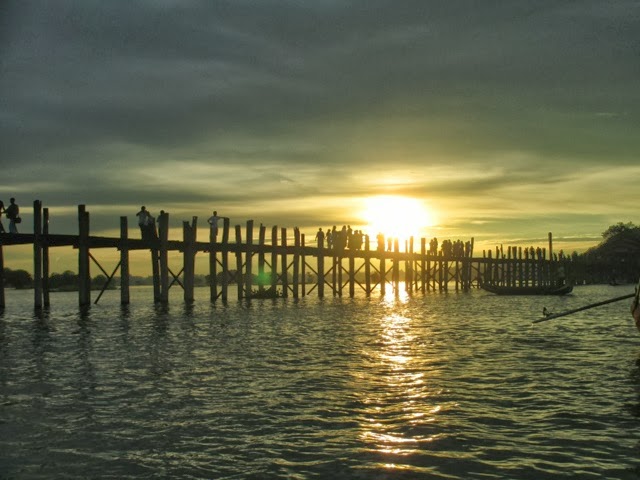
We crossed back over the Ayeyarwady river to see U Bein's teak bridge for sunset. This is the worlds longest teak bridge at 1.2km long and at 200 years old it still sees plenty of action. The bridge was built to enable the villagers working on the other side an easy commute to work! It was full of fishermen, locals, monks, and of course a lot of kids speaking English trying to sell us stuff in a very polite way.


Some locals who took our photos too!

Sunset against the flood waters.
The local jade salesman!


After walking half way we got a boat back to witness the sunset against the bridge. The trifecta of photos was to get a bike, a monk and a woman carrying a bundle on her head - I only managed a bike one!


That night at dinner we came across another idiosyncrasy of Myanmar - waiters calling us all Sir, even the girls! I think they learn the basic English needed for entertaining foreigners (and its certainly more than my very basic Burmese) but without the detail of male versus female titles!

At breakfast the next morning I tried the local noodle and fish soup dish - mohinga - very tasty although a bit too much spice for me in that particular one and I wasn't a hundred percent sure what was in it exactly, but noodles for breakfast is not to be knocked!

That morning we went up Mandalay hill for the views of the surrounding area - you can really tell that it's wet season with the flooded river.


We then took a very luxurious boat to Mingun to see the unfinished pagoda and would have been worlds largest if it had been completed.


The local women fanned us whilst walking around before selling us jewellery and paintings etc...

Mingun also has the worlds second largest bell, weighing in at 90 tonnes, and its the largest bell in the world that can still ring - very loud when inside it!


Another bell action shot!

The final pagoda of the day was Hsinbyume Paya. This is a very impressive white pagoda - considered the Myanmar Taj Mahal as it was built in memory of the kings wife. The white makes it very different to the other pagodas we have seen and a great contrast for the nuns in their pink robes.


That evening we took in some traditional culture at a music and dancing show, where we five were the only people in the audience - they saw us pull up in the pick up truck and jumped up to get ready!


Burmese days

First Impressions of Myanmar started with a view of a pagoda through the rain whilst landing - this is the land of about 5000 pagodas and probably at least 50000 Buddhas, there are pagodas with golden  stupas everywhere!

Next was the red betle nut juice stained teeth of taxi driver, the traffic in Yangon was mad - even for a Saturday evening with monks in maroon robes in the back of a pick up truck being a common site.

The other immediately arresting thing is both men and women in skirts! The national dress is the longi - men wear it to look like culottes and women to look like a normal long line wrap skirt - trousers haven't caught on here like the rest of South East Asia and it seems practical given the climate.

All the women have the home made beauty/sun cream made out of sander wood - decorating their faces like a yellow blusher.

Also notable is the rain - well I am here in rainy season! At least it makes everything green and lush.