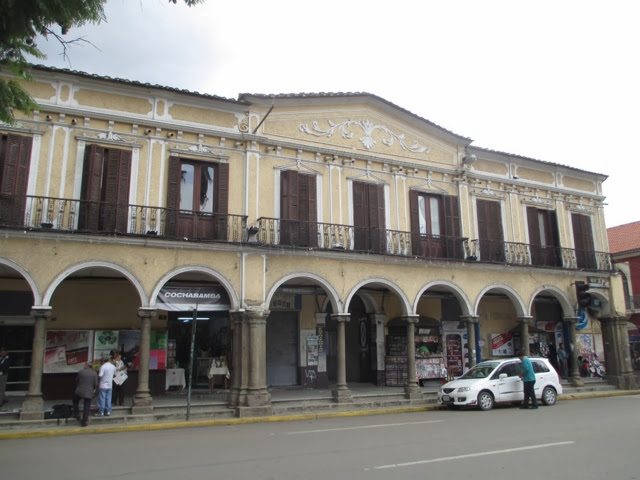
So I know I said we were on the night bus to Cochabamba - and we did get there, but it wasn't very exciting so it didn't deserve it's own post.
We got to Cochabamba - got a taxi to the hostel Las Lilas (waay out of town - there aren't really pack backing places here) and then got the bus back into town to explore.
There are some things to do in Cochabamba - there is Christo Concordia on the hill outside of town, the largest covered market with an interesting witches section, the old colonial centre with, you guessed it, beautiful squares and some lovely gardens. We didn't see all of this due to the weather. Now I knew that Cochabamba department was suffering from the floods - the actual town was fine though - excepting the stream and mud on the cobbled street to the hostel - but it did piss it down all day!
Add to this Cat being ill and not too much out of the city centre got seen... Just the faded grandeur of the colonial squares, the cathedral and some of the covered market (meant to the the largest in Bolivia).
I caught up with an ex Beehiver - Shelley - who was also staying opt our hostel and she was on a shopping mission - so we saw more of the market, including the witches section with its llama foetuses and magic potions. Shelley restrained herself to buying gloves, hats and a Bolivian suitcase - the colourful striped blanket that all the locals use wrapped around their shoulders to carry things in.
I managed to mistake the micro back to the hostel twice (there were 2 routes with the same number - I managed to get on the wrong direction twice! But we found a shortcut the second time so no half hour walk in the mud then!).
Cochabamba buses were very colourful - we ended up in the micro taxis though.
We took an overnight bus to La Paz after spending two days and one night in Cochabamba - our bus turned out to be Cama Suite - flat beds!! Shame I almost froze to death before they turned the heating on. We got to La Paz cold and ready to purchase our weight in alpaca to ensure we would be toasty warm for future journeys!
So our first stop after dumping our bags at Wild Rover hostel was the gringo alley - the street to the left of San Francisco church which is wall to wall stalls selling tourist tat - we were in heaven!! 2 alpaca hoodies and some socks later we were properly prepared for Bolivia, but there was much more shopping to be done...
A sample of all things Bolivian & alpaca
That evening we met up with some of the people from the hostel in Cochabamba and had a few drinks and sampled the Bolivian clubbing experience - both Shelley and I felt worse for wear even after breakfast so the rest of the day was a write off.
Sunday evening we roused ourselves to attend the Cholitas Wrestling. This took place at La Paz' sister city El Alto - both 'cities' have over a million people - El Alto happens to be over 4,000m on the antiplano by La Paz airport - so there were great views over La Paz.
So Cholitas Wrestling - this is exactly what it sounds like - indigenous women in traditional dress wrestling. They did take off their hats and dangly gold earrings - but there were still multiple skirts and pigtails flying! I've got some videos to upload to Facebook....
Cholitas team versus the men - the man with his top off they dragged up from the audience!
Posing with the victor!
There were also men fighting - either each other or the women and the referees frequently joined in also... The wrestling was originally set up for the women to learn some self defense against their husbands but quickly grew into a local attraction - there were lots of local families enjoying it whilst we were there. The wrestling show is more like WWE - all choreographed but still entertaining! Especially when batman flew through the ropes to bowl over his opponent outside of the ring!
Looks like spidey is ref-ing
That evening we indulged in some Bolivian wine and the Sunday roast at Wild Rover - after Shelley and I aced the first round of the pub quiz we retired gracefully....
The next morning Cat and I joined the Red Cap free walking tour. It meets in the square outside of San Pedro prison - where the book Marching Powder took place - apparently you can't take tours inside the prison now, which was good for us as that wasn't going to happen! In the lower security prisons in Bolivia the prisoners govern themselves - so after the gate there are no guards.
The prisoners rent their cells and because they can't afford rent on 2 places their families live with them in the prison - obviously the women and children are allowed to exit the prison for work and school. It's a very different way of operating from Europe! I would recommend reading Marching Powder for the full picture.
From there we headed to the local market - where we saw some of the 400 varieties of potato that Bolivia has to offer. We also saw the Cholitas in their natural habitat. Our guide explained that they can choose to be a Cholita when they are in their late teens. Cholitas are recognised by their pleated full skirts and small bowler type hats perched on their heads. If the hat is worn straight then the Cholita is married - if it's worn to one side she is either single or widowed. If the hat is worn on the back of the head then she's complicated!
Next up we visited the witches market - here you can get potions and tokens to help with everything - from relationship troubles (including getting a man!) to illnesses. Apparently coca cures all - some of the places here also claim to cure cancer... Not sure about that one! We also heard about follow me follow me dust - if you are interested in someone then you purchase this to get them interested and following you - but buyer beware! You blow it in their general direction - but if it's windy you might end up with someone else following you lol!
Llama foetuses - used to bless the land when you build a new house
Graffiti celebrating the Cholitas and the coca the baby is holding.
Next stop on the tour was the market near the Main Street - a concrete monstrosity - however they have the best papas rellenos - stuffed potatoes! This is mashed potato with meat and egg inside - kinda like an empanada but with spicy peanut sauce!
From here we headed to San Francisco church - where the guide pointed out the detailing in the stone work and also told us that there used to be a tunnel from the monastery to the local nunnery! Apparently to get the locals into the church when they were converting them to Catholism, they put mirrors on the outside and inside of the church. The locals thought the mirrors captured th
This carving was demonstrating the evils of drink - see his vomit?!
We then headed to Murillo square - where the presidents palace is. The president no longer lives here - but several presidents got hung in the square (good enough reason to move away?!). Bolivia is used to revolution and overthrowing anyone they don't like, they had 5 presidents in one year... There are also constant protests going on in La Paz - this is normal! Apparently you should be scared when the miners protest as they don't use firecrackers but dynamite!
Statue of the president who was hung - who the Bolivians then decided was an ok guy - whoops
Guards in their uniforms - they whistled when we walked past - not sure how good a job they do!
The current president Morales is the first indigenous president and has made lots of policy changes to benefit the indigenous people and made it easier for the Cholitas to integrate with modern society in the city. He introduced the indigenous flag - which I'll show you later. He has also made a few random comments that aren't politically correct - like Bolivia's version of W Bush?!
We finished up at Vertical Rush - where you can abseil down one of the tall buildings (a hotel) in fancy dress costume. As we watched bacon and spider man made it down - face first!
View of San Franciso church and plaza from the top of the hotel
There are multiple ways of spelling!
The following day we were waiting for Natalie before doing the death road (see separate post) and did a day trip to Tiwanaku - the ancient religious site of the oldest civilisation in South America. The Tiwanakas were around for 27 centuries - as they had no written language people aren't sure why they ceased to operate - political infighting perhaps? The Inca's followed them and were well documented by the Spanish. There are similarities in their beliefs and rituals. The Spanish attempted to destroy a lot of the Tiwanaku ruins - but failed with some of the statues made from volcanic rock - so contended themselves with graffiti-ing Christian symbols instead:
See the cross on the statue's arm?
The flags of La Paz, the Indigenous and Bolivia respectively.
Me in 50% alpaca by the gate in the museum.
Statue with the 7 level pyramid behind - stone for the construction came from both the local area and much further away.
The sun gate - no longer in it's original position (locals had scavenged for the stones from the ruins - Tiwanaku was abandoned when the Inca's arrived in the area).
The Tiwanaka knew a lot about astrology - the temples were all set up with sun and moon gates - they followed both a lunar and solar calendar - which is demonstrated by the twelve sided cross layout of the main temple.
A sunken temple showcases lots of heads in the wall - some of them look like aliens! The Tiwanka royalty practised head deformation so this was probably representative of this.
We also got to see some of the architectural advances that the Tiwanka had practised - including the use of metal I shaped cramps to keep the large stone blocks together and the precise carving that allowed them to cover the temples with decorative gold.
Precision work pre model tooling - in granite!
Tiwanaku was strategically placed 20 km from Lake Titicaca - which was very important for the region. Their is evidence that they had a sophisticated irrigation system of canals. These provided water and fish and the articifcal mounds of earth absorbed the sun during the day and insulated from the frost during the night. This enabled them to get several harvests a year.
A lot of the artifacts they found here were related to religion - e.g puma shaped incense burners and containers shaped like half man half llama - which represented the priest 'class'.
I would recommend this trip - it was fascinating!
The death road followed next - see separate post....
Then on Friday we walked up to the local mirador with Natalie - for great views across the city:
The three amigas - before I got sunburnt!
We went to explore the local hipster area - but it wasn't buzzing during the day, so was a little underwhelming.
We did see this guy in the park - covered with pigeons!
One funky bar/restaurant.
Apparently the area livens up at night with numerous restaurants and bars including jazz clubs.
We spent that evening in Sol y Luna - a little restaurant we had scoped out for an anti valentines night with plenty of wine and some steak! Unfortunately we got asked for dinner after we had finished by a couple of cute guys :s - never mind!
A quick day of shopping for pressies with Natalie and we were all wrapped up and ready to head to Lake Titicaca on the Bolivian side at Copacabana.