Tuesday, 24 June 2014

What's Katie Doing Back in London?

Want to find out what I'm doing now I'm back?

For London focused gin, wine, fun in the sun follow my new blog What's Katie Doing?


Friday, 6 June 2014

13 Backpacking essentials

After travelling the world for the last year I've learnt a few things about backpacking.

There are some essential items and top tips that I've either learnt from experience or have picked up from people I've met:

1 Backpack

The main thing is to have a backpack (doh!) - but a really good one for travelling will be:
- Large enough to live out of, but not to large that it'll be too heavy to carry when full; 
- It will have a front opening zip - i.e. It will open like a suitcase enabling packing and finding things quickly (Unlike a top opening hiking backpack)
- And it'll have a waist strap so you'll be supported when carrying 20 kilos of stuff home!

You'll need more space if you are doing a trip with multiple climates - otherwise try to get away with the smallest bag possible. 


My trusty backpacks - the little one was good for 2-4 week trips and the large one was perfect for my 5 months in South America - thanks Susanna for lending it to me - now I just need to figure out how I'm going to get back to you in New Zealand....

2 Packing cubes

This might sound like overdoing it for some people, but for me it really helped with packing stuff quickly (vital when you need to catch that bus NOW!) and keeping things in order, so clean clothes separate from dirty and everything flat so less creased and ready to wear without looking like you're living out of a bag.

My best purchase from the post office in the last year (they really do sell random travel crap there - check it out next time you're queuing!) Also the travel storage bag is good if you are taking jumpers or bulky items. You put your things in the bag, seal it and then roll to expel the air - so it takes up less room in your bag.


Top tip - put some tumble dryer sheets in your packing cubes/bags to limit the musty smell / cross contamination from dirty clothes!

3 Antiseptic hand gel

I know everyone knows about this one - except I would include you need one that attaches to the outside of your bag. This enables you to use it without touching everything with your dirty hands to open the bag and locate the gel. I saw this first with a Canadian couple on my Morocco trip and then stocked up for me and my friends when I was in the States -  now I see them everywhere!


4 Sewing kit & duct tape

These are invaluable to fixing any of the rest of your stuff - from clothes to bags, to engineering a solution to hold your water next to your bunk (thinking particularly about the duct tape now...). Very worth having around - I used the sewing kit lots.


5 A day bag that doesn't look like a handbag

I would add that it shouldn't look or be expensive either. I had a great little ripstop nylon bag from Kathmandu that was used so much during my year that it's effectively died (even after I sewed it back together - see above). It was a cross body bag that doubled as a beach bag (big enough for a towel), a shopping bag and a carry on bag.

But most importantly it didn't look posh or that it contained anything valuable. It also allowed me to be hands free, but because it wasn't a backpack I could access things without taking it off - useful on public transport when you want to keep an eye on your stuff but hide your camera away.

This seems particularly more important given the few stories I've heard about muggings or potential muggings during my time in South America. The best advice for that is to not carry anything valuable with you and for girls - hide your purse in your bra!

There's no picture as unfortunately Kathmandu has stopped making these bags - RIP!

6 Flipflops

Invaluable in any hot climate - potentially the only shoes you'll need if they are nice enough and your not climbing mountains!


My lovely Havianas!

7 Medication

Always take a medical kit - it doesn't need to hold much, but those plasters, paracetamol and rehydration sachets will be great when your ill, whether it's self inflicted or not! If you can get them, take a course of general antibiotics too - if you go to Asia you can buy these cheap there. Definitely what you need when stuck somewhere without a proper pharmacy when you are ill enough to need them. 


(Ps lack of pharmacies doesn't appear to be a problem in South America - they were everywhere! But maybe not up a mountain...)

8 Pack valuables in your hand luggage

After a couple of friends lost bags or had them go walkies when flying this advice is more relevant. Pack your valuables in your hand luggage. So that's your phone and charger, your jewellery, any irreplaceable souvenirs and if you have space a change of clothes. That way if your main bag doesn't turn up at least you have something clean!

9 Neck pillow, earplugs and eye mask

Even if you aren't doing mega long bus rides (although if you are travelling as a backpacker you probably will - the savings compared to flying buy many beers!) a blow up neck/head pillow will allow more comfort anywhere. On the plane, train, bus or even in the tent or hostel bed.


Ear plugs and eye masks are the best way to ensure a good nights sleep in the dorm room - so even if your roommates are being inconsiderate you won't get disturbed when they chat and turn the light on (well hopefully - depends exactly how loud they are!)

10 Washing line, sink plug & hand washing powder

Only really relevant in hot countries where you'll have space to hang stuff to dry - so ideal for the beach! However I did leave my washing line in Cambodia and didn't need another one for the last 6 months of my trip. Most places if you need to get washing done will be cheap (exception was Brasil but it was the cleanest any of my stuff had been in 7 months!), however if you only need to do your swimsuit or knickers then this is useful. 

11 Padlocks

To secure your stuff - e.g. your bag when you chuck it on that overnight bus, or to lock valuables in a locker when staying in a dorm room. Get TSA approved locks if you transit through the US and take a few - I found the combination locks most useful. 


12 Chargers & travel adaptors

If you have USB charging cables take a dual USB travel adaptor with you. If not at least make sure you have travel adaptors that work in the countries that you are visiting. Universal travel adaptors can be found at the airport, the post office, that random shop on the high street - you get my drift!


13 Caribiners

Absolutely vital for attaching stuff to you or your bag. 


The lipsalve sling was also useful!


And finally take less stuff!

The old adage goes that you should organise everything you want to take with you and lay it all out. Then pack half the amount of stuff and take twice the money - you can always buy stuff when travelling and this might be a good way to double up the usefulness for souvenirs. Although I don't agree with wearing things before giving them as gifts (you know who you are!)

Also taking less stuff leaves room for those souvenirs - you don't want your bag full before you leave, athough the holy grail moment when you can arrange your bag to get those trainers to fit in is amazing!

Now I'm back from my travels what am I going to do?

Well you can find out on my new blog - What's Katie Doing? - and follow my exploits in London and attempts to get a job :)


Wednesday, 28 May 2014

Best travel apps

One of my essential pieces of kit - after a camera of course - was my iPad mini.

The size is similar to a kindle and with the kindle app I didn't need to pack both and could keep my reading addiction up to date easily (not sure how much I spend downloading books but it was a lot even with amazon vouchers!)

So I've decided to share my favourite apps for travelling:

Kindle - for reading and saving/viewing documents


As mentioned a great app for ease of use downloading amazon purchases or even their free books (many classics are free).

You can download books to read on your iPad and iPhone and sync the two if needed. Also you can read and save PDFs and other documents.

This was indispensable for me, I saved my travel insurance policy, my itinerary and lots more!

Cost: Free to download to both Apple and Android devices from Amazon 

Blogger - for writing and publishing blogs to blogspot.com


The blogger app from gmail is a great way to get started with blogging and this app makes it easier to write offline and add photos etc without needing to use third party computers with all the attendant virus risks.

I've used this for the past year to keep my blog up to date and the only caveat I have is that I didn't create my blog on it so I can't comment on that. The app has really come a long way in development in the last year although I still can't load videos through it.

Cost: Free to download, anyone with a gmail account can create a blogspot.com blog via gmail and from conversations with other bloggers it's a lot more straight forward for beginners than word press

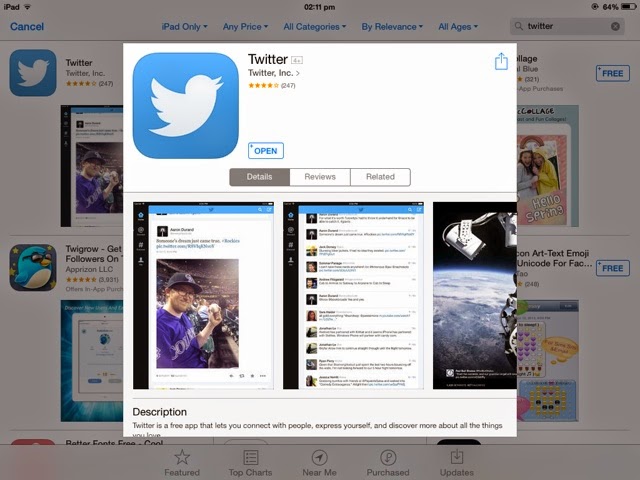
Twitter - for communicating with the wider world ;)


This is a multi functional app for me - I post my blogs on twitter so they are searchable and accessible by people I'm not friends with on Facebook, and twitter posts this info to Facebook too, I don't have to do it twice.

I use twitter for information and events, to share comments with others and to get inspiration.

It's also a great way to contact companies - e.g. I recently tweeted United to ask about leaving the airport during a layover (I didn't leave the airport in the end but United answered super quick!). I also used it to contact the British Embassy when we thought we might get stuck in San Agustin, Colombia, due to strikes and road blocks! The Embassy answered fairly quickly but were unable to help much - never mind we got out alive...

Cost: Free to download

Moldiv - for editing your photos 


Got a lot of photos and want to share but don't want to post them all separately? 

Need to photoshop someone in/out of a photo?

Well Moldiv is the app for you! 

Being able to combine photos in different ways is Moldivs strong point. Having only discovered the 'photoshopping' function - being able to cut people out of one photo and then add them to another - I haven't made full use of this, but I think Facebook will appreciate it in times to come!

Here's an example of what I've managed to do with it - imagine what you could do with lots of time & practise...


Cost: Free to download

Dropbox - for sharing photos


This is a good app for sharing photos with people you meet on your travels but perhaps aren't Facebook friends with (or when one or the other of you is trying to hide the fact that your travelling when work thinks you're sick!).

Unfortunately I filled mine pretty quick with backing up photos from my iPad (not enough capacity when you're filling up 16 GB SD cards!). The app allows you to share folders of photos, view other peoples folders and download photos from them.

Note: if you have a google/gmail account then you can use picasa or google plus to backup photos. You can also share these with other people and post links to the albums to Facebook etc, however it's a web based access rather than an app and downloading photos to an iPad seems impossible (you can't expect android to talk to apple!)

Cost: Free to download 

Touchnote - for turning your photos into cards


Still talking about photos - I love this app! It enables you to turn a photo into a postcard or other type of card (birthday, random occasion etc) and sends it to your friend/ family member in whichever country they are in.

I've used it for my Dad's birthday card and postcards to friends in several countries and I'm sure it will come in handy for the future. You can also order in bulk - e.g. Design a Christmas card and print lots to be delivered directly to you to then send out, or to send directly to a group of people.

Cost: free to download

Skype - for video calling and cheap calls


A great one for keeping in touch with peeps back home - like the bank when your mobile doesn't work and your card details have been stolen...

You can video call anyone with Skype, you can phone any number with Skype credit and it's away cheaper than using your mobile abroad.

Does require a wifi connection though and sometimes the video can freeze if the connection isn't fast or strong enough

Cost: free to download

FaceTime - to video call other apple users

The Apple only version of Skype - you can video call or message people who are also on an Apple product (as long as you have the email address their device is registered to in your contacts). I use this a lot to talk to family - especially right now given that my phone isn't working :s 

Cost: free with apple devices, works with front facing cameras only

My Orange/My EE - to keep track of your mobile phone credit


Now that Orange is basically EE (but not quite - I'm not sure what the rebranding was about at all!) these apps try and do the same thing, which is to let me know how much I've spent on my phone. 

Great for PAYG customers trying to keep track of their credit without having to use it to phone Orange from abroad. Not the best app for monthly contracts - I was never able to register properly...

Cost: free to Orange/EE customers

Google maps - to get around in foreign parts!


Not always better than just googling a place - but useful to get directions and see what else is nearby. 

The only downside over using this rather than just taking a screenshot of the web page is that it shows the maps in local script, unfortunately I don't read Arabic or Thai, but this was useful when showing taxi drivers where to go.

Cost: free to download

FairFX & other credit card apps - to keep track of your money


I've particularly mentioned FairFX as these prepaid credit cards are super useful when travelling (especially after I got my barclaycard details stolen). 

The app makes the experience even better - the transactions are updated real time so you can check exactly how much credit you have left, you can set up payment options to load money onto the FX card simply and quickly and you get a decent exchange rate for foreign currencies.

I've also used the mobile/iPad apps for my other credit cards and they've also been useful to keep track of your bills whilst travelling, but none are as easy as FairFX!

Cost: free to download - you'll need to apply for the card first to be able to use it

Trail Wallet - to budget your trip and keep track of expenses

It looks like this app can no longer be downloaded, which is a shame as it's a great budgeting & expense tracking application.

I particularly like the feature of being able to set up multiple currencies and it translates these back to your home currency. It's flexible so you can set up your total budget or budget by day and it'll show you both, it averages your expenditure against the total so even if you go over one day you can be reassured that you haven't broken the total trip budget.

The pie chart of expenditure also appeals to my inner accounting geek and the sarcastic comments when you go over budget are funny!

Not sure what to recommend in its place - there are plenty of similarly functioning apps out there, so google travel budget & expenses to see a selection.

Cost: This one was free to download but only allowed 30 transactions to be entered before you had to pay and upgrade - but for around £1.50 this isn't much and that seems to be the going rate for similar apps on the app store at the moment

Banking apps - for checking you've got the money!

Sorry for the generic title - I don't want to big up anyone bank in particular. A mobile banking app is invaluable for being able to access your account information and transfer funds quickly and easily. 

I wouldn't use your normal debit card when abroad for a long period of time - this is where FairFX and similar cards should come into play - but being able to access your current account &/ savings account is key.

Cost: most banks have free apps to download to mobiles and tablet devices

Xe currency - For converting currencies


How much does that cost in real money? Just check it out on xe currency converter - you preset yr currencies and then enter the amount of the relevant one and it shows you how much that is in all the rest. 


E.g. £65 is 205,900 COP or 889 Argentine Pesos (top tip never change money officially in Argentina - you'll get a way better rate on the 'blue' market).

The only thing to be wary of is that the rates that xe source are interbank - you are unlikely to get such good rates as a tourist, however it's great as an indication and even better if you're FX trading!

Cost: free for the basic one - the pro version costs but you'll only need this if your trading FX. Don't pick the wrong one!

itranslate - to translate from one language to another


This one is a good app for translating from English to Spanish or vice versa. This is better than just using google to translate as it keeps the translations in the history - allowing you to show the pharmacist exactly what you need when offline (Nb the old school way to do this is to use a pen and paper...)

Cost: free

United app - for all your United airlines needs


This one doesn't have to be specific to United - any airline app would be useful as long as it's the one you've got flights with! I like the functionality of this one - your reservations, electronic boarding passes, mileage information are all in one place. 

Even better it has free sudoku!

Cost: free

Airstash+ - for extra storage and sharing films when used with the Airstash USB stick


If you like to watch films etc on long bus journeys this is a perfect app. Rather than filling the memory of your iPad you save films, TV shows, music, photos on the Airstash USB stick (you need to plug it into an actual computer to load stuff on).

Then the inbuilt wifi in the Airstash USB means you can access from any device - including iPads that don't have USB ports. Even better you can share films etc with up to 3 devices at once via this app and the wifi function.

The only drawback with this is that when working with iTunes you can't share content :(

Cost: the app is free to download but the wifi Airstash USB does cost a lot - check out Amazon for latest prices and be aware that you usually have to buy an SD card separately.

Games - Solitaire, Marble Mixer, Flightctrl HD:

Solitaire

For when you want to be alone and play alone.

Cost: free!

Marble Mixer

Great for playing with kids of any nationality - I've played with children in Cambodia and Ecuador!

Cost: depending on version free or $1.99
 
Flightctrl


Strangely addictive - just don't play it too much on the plane with the crash sounds turned on!

Cost: not sure how much I paid for it - but it may have been £1.50 and it was totally worth it!

Tuesday, 27 May 2014

Round up of a year travelling

I started out at the end of April 2013 flying to Jordan and Lebanon with my friend Cat (CBH).

After 34 flights and 20 countries I've ended up back in the UK.

I've visited 5 continents - North & South America, Africa, Europe and Asia.

Of the 20 countries and 18 pages of my passport filled, 14 were new this year and I would still go back and revisit them - there is never enough time to see everything!

My trip covered the Middle East (Jordan & Lebanon), to Northern Africa (Morroco), Europe (Lisbon & Turkey), the USA (from Hawaii to the California, Utah, Nevada, Arizona, Denver, Chicago, Washington DC, NY and numerous national parks), Asia (Thailand, Myanmar, Laos, Cambodia, Vietnam, Hong Kong) and ended in South America at the end of May 2014 (Argentina, Uruguay, Boliva, Chile, Peru, Ecuador, Colombia).

I paid for the Galapagos by selling my car :) (tips on visiting the Galapagos on a budget can be found here: http://katiesyearoff.blogspot.co.uk/2014/03/galapagos-on-backpacker-budget.html?q=Galapagos )

Otherwise I've used the ill gotten proceeds from my job working in banking to fund my travels. I'm quite proud of myself for not working for over a year :). Now I'm broke - so if anyone has a job for a finance professional let me know!

And what was the best bit of my travels I hear you ask?!

Well it's not a particular place - although I think Bolivia was the most surprising....

It's the people.

The interactions I've had with different people around the world make the experience. From great travel mates, Cat BH, Cat & Tiva from home; Kitty, Carmen & Cameo in Asia and others I've met at hostels and bars along the way; to the local people like the Bedouin lady at Petra, our Palestinian grandad driver, the ladies living in Sapa, the kids in Quito and Phong Nha, my host family in Quito, the stalkers, the hostel owners/workers, the tour guides & groups, everyone who has given me a couch to stay on and of course the bar tenders :)

It's you that have made my year complete - thanks!

Now I'm back in London I've a couch going spare - come visit me anytime and I'll show you the secret pubs of Camden! (Oh yeah the food and drink was runner up for best bits!)

Some of my favourite pictures from the last year, believe me there were too many to choose from!


Starting at the beginning - Petra in Jordan, the Dead Sea, turbaned up for the Sahara


Ballooning in Cappadocia, mud men, Lisbon castle and unusual modes of transport!


The US from Grand Canyon to Dener,
 Chicago, Vegas & DC


Burma (Myanmar), Laos, Angkor Wat & beer towers!


HaLong Bay, dressing up for a wedding in Burma, homestay in Battambang, beers on the boat, kissing the Buddha & mud wrestling in Vang Vieng after tubing

Thinking in DC, Lao Lao at the homestay in Laos, Mui Ne fisher woman, margaritas in Denver & mediating in Angkor Wat

Wine tasting Uruguay, New Year's Eve in Punto Diablo, Colonia, camping on the Caribbean in Colombia, Colca Canyon Peru & carnival in Cusco!

Trying out a tortoise shell for size in the Galapagos, volunteering in Quito, Macchu Pichu in Peru, swing at the end of the world in BaƱos Ecuador.

Thursday, 22 May 2014

A day in the life of a volunteer at UBECI Quito

Me and Lady at the Thursday market - she shared her sticker with me!

The day starts with breakfast provided by my host family - Mayra and Wilson. This usually contains hot water for tea and hot milk for coffee, some fruit, yoghurt and bread. Lots of the volunteers stay with families in their homes - this has let me practise my Spanish with the family, including the children Alison and Josue, as well as becoming immersed in Ecuadorian culture. I share a room with Felicia and there are two other girls staying in our flat with the family at the moment.

Set up for the day, my house mates and I head off to the Volunteer Connection Ecuador (VCE) office for Spanish lessons in the morning. My teacher Laura usually works me hard! We go through lots of vocab and learn new verbs, with some games to test me and keep me on my toes! After some confusion on my part I think I've learnt a lot more to be able to talk to the staff in Spanish (well for basic things!)

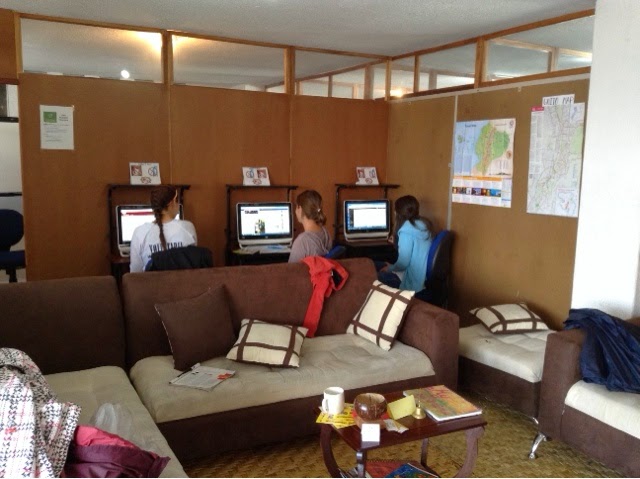
VCE office - Volunteers can use the computers for Internet and those working with the admin team for the projects they are working on.

A break for lunch allows us time to grab either a complete meal for $2.5 from Mayra's restaurant Los Seccos under the flat, which includes soup, main course with rice, desert and juice, or a snack of tamales or humitas for around a dollar for two from a local stall around the corner from the VCE office.


All of the above for just $2.5!

Then for the part timers like me it's off to the UBECI - United to Benefit Ecuadorian Children International - office around the corner. I am living within 5 minutes walk of both offices in the barrio of Villa Flora in South Quito.

Map of the area around the offices in Villa Flora

UBECI staff run a weekly meeting every Tuesday to explain to the volunteers the activities for the children for that week - different depending on the age group. Danny heads up the 1-3 year olds, Lule keeps the 4-6 years occupied and Christine helps out the 6+ children with homework as well, with some help from Oriana - a full time long term volunteer. Director Alicia holds down the fort in the office when the staff head to the markets every day and it's her that ensures us volunteers get on the right bus for the afternoon sessions!

The street & working children program schedule

We turn up at 1pm and get directed to the correct bus - then it's off to one of the markets (they go to different ones every day). On arrival the full timers that have been there in the mornings are usually playing with any children that have turned up early. If they moved to a new location for the afternoon then we set up a washing station - for the kids to wash their hands and faces before they start playing - this is important to help instil some hygiene awareness and so the kids hopefully go home a little cleaner than they came (not always possible if we do painting!)

Then the play mates are set up - it's important to have somewhere to put the toys out and let the kids sit down and play that's relatively clean. Working in the markets means the floor can be dirty. The various toys and books are put out and if there is space a pelota or ball is also kicked about. The kids have some free play time with the volunteers whilst the small ones are picked up from their parents by the staff. 

Helping with puzzles (this is really like play time for the volunteers too!)

When everyone is ready and has had a chance to work off some excitement with the toys and puzzles the staff get the children involved in some group activities. This can be playing physical games to help with their coordination, or singing songs with actions involved. Unfortunately I only know the words to some of the songs like Mi Cuerpo and the rest I try and join in with the actions and the few words I do know!


Then the children are split into their age groups and go to do their different activities. I've been helping Danny with the 1-3 year olds and the activities over the last 2 weeks have included playing doctor and reinforcing that the kids need to tell their parents when they are sick and that they need to see a doctor, to fine coordination skills ripping up paper or making and throwing balls out of magazine pages.

We also did some colouring in of niƱo and niƱa pictures - after talking about who is a boy or girl and what makes them different. When we are finished with the age focused activities the kids line up to receive stickers - those not lining up forfeit this right and they all want stickers! Then we sing the goodbye song - in Spanish and English - and the staff and volunteers take the smaller children back to their parents.


Lining up for stickers and goodbyes!

Then it's up to the volunteers to pack up and make our way back to the UBECI office with the toys and mats etc.

The objectives of the street & working children market program - even in a few weeks you can see the children benefitting from their time in the program. Eventually when they are old enough the parents commit to the children attending school, so far this has been really successful.

My host family then provides dinner - usually local Ecuadorian fare of rice and some meat with a salad or plantains and drinks. There is no smoking or alcoholic drinks allowed at the homestays out of respect to the families. This doesn't stop the volunteers venturing out into the Mariscal area of Quito (aka Gringolandia) for a drink and a dance every so often!

There is also plenty of opportunity for volunteers to see the sights in and around Quito (this will be a separate blog post coming soon!), here is a quick taster of some of the sights:

The Virgin at the top of El Panecillo lit up at night

Plaza Grande

La Basicila